Physician-Founded | Mechanism-Focused | Clinician-Reviewed
Physiology-Guided Cardiovascular Prevention
A mechanism-based approach to identifying early dysfunction, guiding targeted intervention, and measuring physiologic improvement
CPET-Insight organizes complex exercise physiology into transparent decision-support outputs for qualified clinician review
The Challenge
Disease Develops Long Before Symptoms
Disease begins at the physiologic level - long before clinical diagnosis
Standard testing detects disease in the later stages
CPET-Insight supports recognition of cardiometabolic dysfunction in early stages
Atherosclerosis is the driver of cardiovascular disease (CVD). It starts in early adulthood and results in gradual degradation of vascular function and structure over time. Atherosclerosis is driven by modifiable risk factors that impair vascular function long before symptoms appear. Endothelial dysfunction (ED) is the earliest measurable stage of atherosclerosis and represents a reversible window of opportunity that standard workup consistently misses
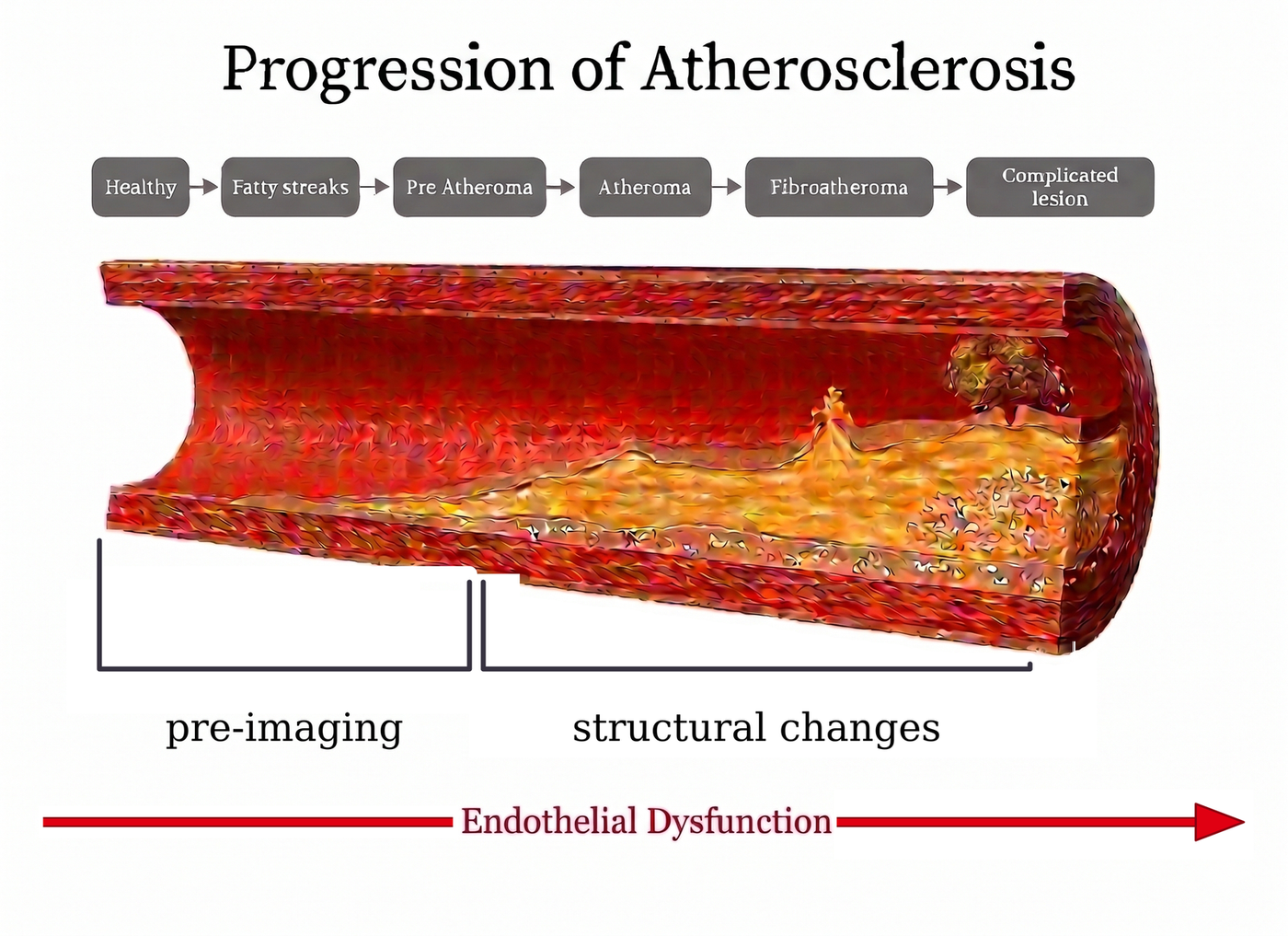
Later stages of atherosclerosis result in structural changes to the arteries, particularly the coronary arteries in the heart. By the time traditional cardiac testing (stress ECG, echocardiogram and imaging based modalities) reveal abnormalities, the window for intervention without permanent structural consequences has frequently passed
The Framework
A Mechanism-Based Model of Disease Progression
This progression is measurable and reversible when identified early
CV Risk Factors and Heart Disease
Modifiable Risk Factors
- Obesity
- Diet
- Sedentary
- Smoking
- Lipids
- HTN
- Insulin Resistance
- Inflammation
- Stress
- Sleep apnea
- Environmental toxins
Unknown Risk Factors
Genetics
(Family History)
Nitric Oxide (NO)
Endothelial Dysfunction
(Cardiovascular-Kidney-Metabolic Syndrome, CKM)*
(Alterations in Stroke Volume & Heart Rate Response)IT
1 mL/kg/min decrease ≈ 10% increase mortality
Cardiovascular, kidney, and metabolic disease are interconnected through shared vascular pathophysiology
* 2026 AHA/ACC CKM Risk Prediction Scientific Statement (Khan et al., Circulation)
Our Approach
Targeting Dysfunction Before Disease Develops
A Reversible Target
Endothelial dysfunction is the earliest detectable and most treatable stage of cardiovascular disease
Endothelial dysfunction (ED) is the physiologic bridge between modifiable risk factor burden and structural cardiac damage. Because ED is reversible, identifying it at this stage creates a clinically actionable window. Targeted intervention - addressing the upstream metabolic drivers - can restore endothelial function, improve exercise capacity, and prevent the irreversible structural changes that define late-stage disease. By identifying subclinical cardiac dysfunction, interventions are implemented at an earlier point to reverse ED and restore Peak VO₂ to personal optimal levels
The differentiator is timing: identify and treat the early dysfunction
Key Innovation
The Inducible Threshold (IT)
Earlier intervention becomes possible when abnormal physiology is measurable during cardiovascular stress
Dr. Chaudhry pioneered the CPET-based identification of IT as an early physiologic marker of exercise-induced cardiac mechanical dysfunction
Expert interpretation is required to distinguish true pathologic patterns from artifact, protocol effects, and normal physiologic variation
A reproducible hemodynamic marker showing when vascular dysfunction begins to impair stroke-volume response during exercise
IT marks the workload where O₂-pulse begins to plateau and heart rate accelerates to compensate, revealing impaired stroke-volume reserve under stress
Detectable during exercise CPET - before overt cardiovascular disease develops
Often reversible with clinician-directed risk-factor modification, making serial CPET useful for tracking physiologic response over time
When IT is present, the goal is to move the threshold higher, resolve the abnormal pattern, and restore physiologic reserve
The Closed Loop
Early Recognition to Reversal Tracking
Unlike traditional models that focus on identifying established disease, CPET-Insight supports a closed-loop system for tracking physiologic progression and response
Early Recognition
CPET reveals the physiologic signature of endothelial dysfunction and identifies IT, an early measurable marker of impaired vascular response under stress
Targeted Intervention
Mechanism-based findings support clinician-directed action on the upstream drivers - metabolic, inflammatory, hemodynamic, and lifestyle-related
Reassessment
Repeat CPET measures the physiologic response to clinician-directed care, showing whether IT, O₂-pulse, heart-rate response, and Peak VO₂ are improving
Objective Improvement
Resolution or upward shift of IT, rising O₂-pulse, and improved Peak VO₂ show measurable recovery of vascular and cardiac performance
By addressing modifiable risk factors, endothelial function improves, cardiac performance normalizes, and Peak VO₂ returns toward personal optimal values
The Metric That Matters
Peak VO₂: The Ultimate Integrator
Peak VO₂ integrates cardiovascular, pulmonary, and metabolic function into a single measurable outcome
reduction in all-cause mortality per 1 mL/kg/min increase in Peak VO₂
Explore Peak VO₂ and PrognosisClinical Fit
Where Physiology-Guided Prevention Adds Value
CPET-Insight is most useful when clinicians need to identify early dysfunction, personalize intervention, and track whether risk is actually improving
Cardiometabolic & Preventive Care
- Identify early physiologic dysfunction in patients with obesity, insulin resistance, hypertension, dyslipidemia, or family history
- Support clinician-directed risk-factor modification before symptoms or structural disease appear
- Track IT, O₂-pulse, heart-rate response, and Peak VO₂ as objective response markers
Obesity, GLP-1 & Lifestyle Programs
- Shift the endpoint from weight alone to preserved or improving physiologic reserve
- Pair medication, nutrition, and exercise strategies with serial Peak VO₂ tracking
- Distinguish improved risk-factor numbers from true improvement in functional capacity
Executive, Occupational & Self-Insured Health
- Find high-risk physiology in people who may still look well by standard screening
- Measure whether wellness and prevention programs are changing cardiovascular trajectory
- Use objective serial physiology to support early intervention and long-term risk management
Physiology-guided prevention shifts care from reactive to proactive risk management
Ready to Bring Physiology-Guided Prevention Into Your Practice?
See how CPET-Insight integrates into your practice